Nidhi Mukherjee, 1/29 Week 10 - Emphasis, My Lad
I didn’t eat the leftovers.
I didn’t eat the leftovers.
I didn’t eat the leftovers.
I didn’t eat the leftovers.
Four different meanings. One sentence. Not the same sentence.
Right?
In one word, it’s all about emphasis.
In more words (anything to hit the minimum word count), the art of communication relies heavily on emphasis, which is composed of inflection, speed, volume, and pauses.
But, emphasis does not have to be verbal—in fact (see what I just did here with the em dash?), it can be used in written rhetoric through the modification of syntax, diction, and style. We, the proud AP English students, should know. We’ve been analyzing rhetoric since—dare I say—we’ve been in diapers (see what I just did there with the hyperbole?).
But, in all honesty, emphasis is—to put it frankly—pretty darn important. I mean, can you imagine if we didn’t have varying degrees of inflection and volume in speech? Or if I wrote my blog in a long, boring, mundane, tedious, repetitive, banal, monotonous, dull…you get the idea.
And let’s not forget the rhetorical device I single out in every one of our annotations: diction. Think “very good” versus “marvelous.” I would be pretty pissed if I got one in exchange for another. I’ll let you all figure out which one is which.
And then, there’s syntax.
My dearest. My lovely. My gorgeous, beautiful, potent…okay, now we’re getting back to diction. I’ll stop.
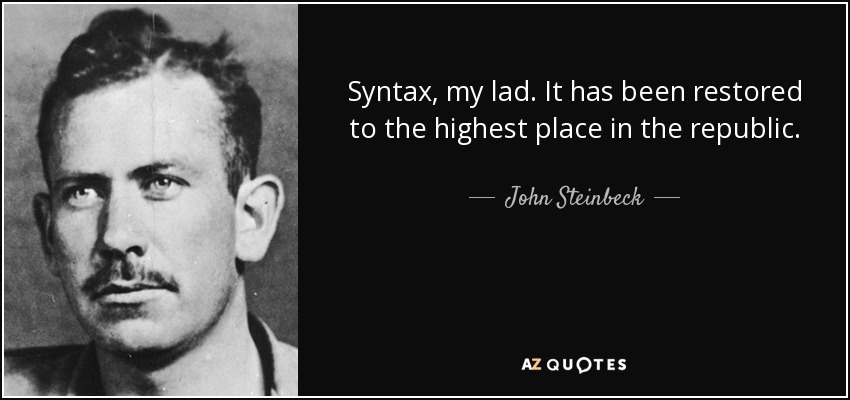
But, the point is, syntax, as the American writer John Steinbeck put it, “has been restored to the highest place in the republic.”
Power of syntax - courtesy of A-Z Quotes

And, as is diction.
And style.
And emphasis.


Hi Nidhi! I really love the sense of humor that you wove throughout your blog–from your own interjections interrupting your theme and your “rant” about the beauty of grammatical syntax–with your own use of syntax, diction, and literary devices to portray your own proficiency. I find it so interesting how mere symbols can carry so much meaning in our everyday language by giving visual representation the emphasis and pauses that we naturally have when we speak. I absolutely agree that communication is an art form. Your listing of “inflect, speed, volume, and pauses” reminds me a lot about my piano teacher’s constant reminders about the important components of a piece that a great musician should be able to control: things like volume, tone, touch, and visual poise. In my mind, language is a kind of music in and of itself–something that people can craft and hone in order to capture the audience. A piece can be performed with perfect accuracy, just as a speech or article can be written with perfect grammar. Yet it's the ornamentation that captures the audience’s attention, just as it’s the careful crafting of words that keeps the audience reading or listening. That’s the kind of performance that stays in the minds of readers long after they are done listening to the piece. I also liked your allusion to your main quote from Steinbeck that captures the essence of your post, while still having your own spin on the idea in your title. Thank you for sharing!
ReplyDeleteHi Nidhi, I love how you started your blog; I feel that most people naturally learn how to emphasize words in speech, and we don’t entirely realize how important it is until it’s pointed out. Also, I love how you incorporated humor into your writing (I wrote this to make my comment seem longer). Your usage of parenthesis (and emphasis, of course,) makes your blog especially interesting to read.
ReplyDeleteI honestly would love to dive deeper into learning about the different types of emphasis. Intonation, inflection, and speed are often not discussed as all; they are naturally learned by almost everyone, yet it’s difficult to describe until someone explains it to you. It’s different in most languages as well, adding more complexity to emphasis as a concept.
I really admire your writing style. You make it flow so beautifully and naturally—it has personality. Do you write similarly in rhetorical analysis essays as well, or is your writing style more blunt in that setting? For me, I feel like I write everything as plain and simple as possible in my writing, and because I have so little practice with any other sort of writing, I find it really difficult to achieve the “vivid voice” necessary for the sophistication point. Thank you for sharing!
Hi Nidhi! I usually never say this to other people but your blog was genuinely so fun to read! It was entertaining to see you use emphasis in such a fun way, it was almost as if I could hear your voice while reading it. Before reading your blog, I thought the only possible way to add emphasis in writing was through punctuation marks. I don't know why I never thought of using figurative language like hyperbole for emphasis. It’s so creative how you structured your blog, first by starting the blog with an example of emphasis and its significant impact on the meaning, and ending the blog with phrases that start with “And”—which again creates your own unique starting of writing. I'm thankful for emphasis because they make your blogs fun to read!
ReplyDelete